
Around 3000 BCE: The Cycladic Civilisation
People have lived on Naxos for thousands of years.
Around 5,000 years ago, Naxos was an important centre of the Cycladic civilisation. People sailed between islands, traded goods and carved small figures from white marble. Marble would become one of Naxos’s greatest treasures.
Around 530 BCE: Ancient Greek Temples
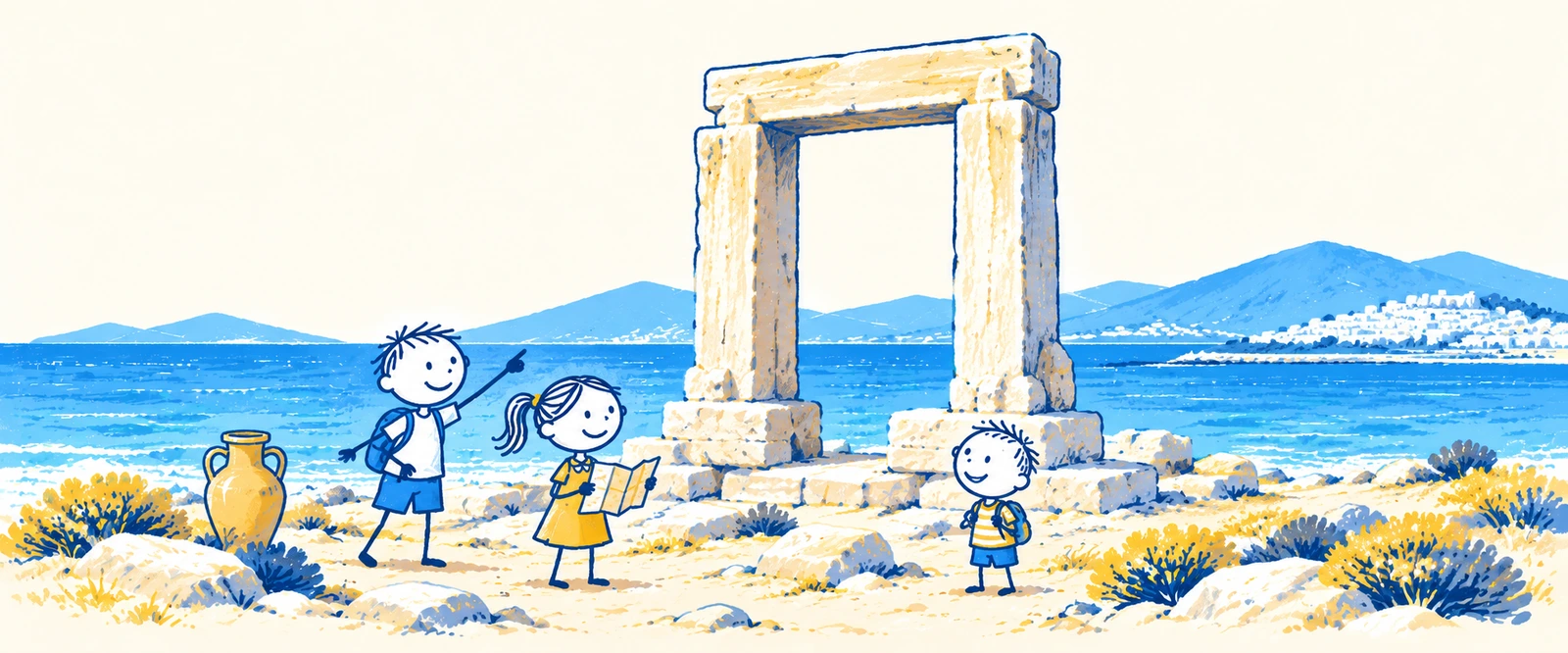
Later, the ancient Greeks built temples to honour their gods. Around 530 BCE, they began constructing an enormous temple near Chora’s harbour. It was never completed, but its giant marble doorway, the Portara, still stands today.
Elsewhere on the island, you can discover unfinished giant statues called kouroi.
41–324 CE: Roman Rule
From around 41 CE, Naxos became part of the Roman Empire. Roman influence lasted for nearly three centuries. The island remained connected to important trade routes, while Greek language and traditions continued alongside Roman rule.
324–1207: Byzantine Rule
From 324 CE, Naxos became part of the Byzantine Empire, the eastern continuation of the Roman Empire. Christianity spread, and churches were built across the island. Some still contain paintings that are more than a thousand years old.
1207: The Venetian Duchy
In 1207, a Venetian nobleman named Marco Sanudo conquered Naxos and made it the capital of a small island duchy. He built the castle overlooking Chora, where you can still wander through narrow medieval streets.
From the 1500s: Ottoman Rule
From the 1500s, Naxos came under Ottoman rule. The island was governed by Ottoman officials, but many local customs, villages and Christian traditions continued. Naxos also kept trading with other Aegean islands and with places around the Mediterranean.
19th Century: Part of Greece
During the early 19th century, people in Greece began fighting for independence from the Ottoman Empire. The Greek War of Independence started in 1821, and the new Kingdom of Greece was established soon afterwards.
Naxos became part of the modern Greek state in 1832. During the 19th century, life on the island was still mostly rural. Families grew grapes, olives, wheat and potatoes, raised animals and worked with marble.
Today: History All Around the Island
Today, Naxos’s history is everywhere: in ancient temples, abandoned marble statues, Byzantine churches, Venetian towers, Ottoman-era buildings and traditional villages.
Everywhere you explore, you are walking through another chapter of the island’s history.