A lovely village with life all year round. Arriving from Naxos Town (Chora), park in the car park just beyond the village, then explore the little streets on foot.
Where to eat? Our favourite is Mitos, for Naxian potatoes prepared in all sorts of ways and excellent salads that make a change from the usual Greek classics. Right next door, Galanis serves traditional Greek food: we enjoyed a good, inexpensive meal and friendly service.
Some terraces deeper in the village have prettier settings, but we found the welcome less warm with children at a few places. Several did not accept cards when we visited, so bring some cash.
Cafés and local treats: there are plenty of lovely little cafés. Try portokalopita, the orange cake soaked in syrup that children love. Browse the shops selling local and organic products; honey from Iraklia is a particular favourite of ours.
Apeiranthos is a mountain village with marble-paved lanes, vaulted passages and small squares lined with cafés and tavernas. Its stone houses and museums reveal a distinctive side of Naxos.
Naxians say it themselves: you can recognise people from Apeiranthos by their accent! The village has its own distinctive way of speaking, often compared with that of Crete. A local tradition links some families to Cretan arrivals after the revolt of 1770.
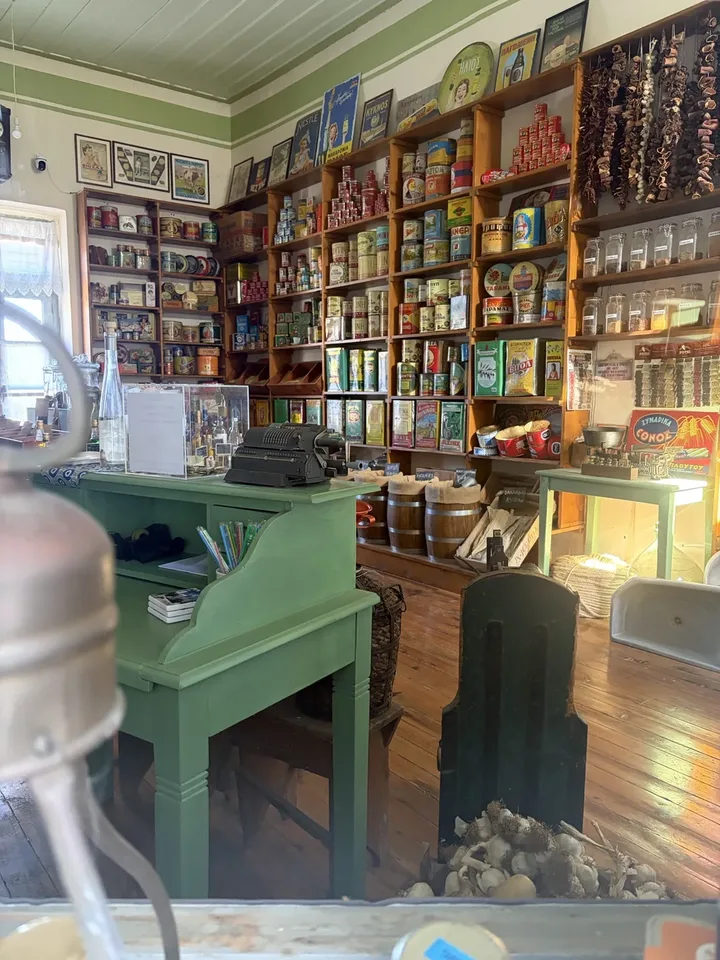
Another stop worth making is Theonas, a traditional family-run shop with a nostalgic old-grocery atmosphere, vintage utensils and local Naxian products.
Filoti
At the foot of Mount Zas, Filoti is the largest village on Naxos, with 1,610 residents in the 2021 census. For our family visit, Fassolas, the old market quarter, was the main sightseeing stop. The rest of the village is best enjoyed by wandering through its lanes.
We found the visitor experience very seasonal: outside the main season, expect a quieter atmosphere and fewer places open. Explore the uphill lanes according to everyone’s energy.
Combine your visit with: travel from Filoti to Aria Spring, the starting point for the walk to Zas Cave. Allow 20–25 minutes uphill from the spring, plus the return; this does not include the journey from the village.
Estimated visit
45–90 min
Parking
At the edge; availability varies
Stroller / carrier
Partial centre access; possible steps
Food
Visitor facilities are very seasonal; check opening times
Potamia is made up of three villages in a row — Ano, Mesi and Kato Potamia — in a very green valley. It is not necessarily a must-see village visit in itself, but a pleasant stop for lunch or the start of a walk. In Ano Potamia, we really like I Pigi, « The Spring ».
A tiny village with a restored olive press and the real working studio of Manolis Lybertas, a fourth-generation potter. You can watch him working at the wheel when he is making pieces; this is neither a scheduled demonstration nor a pottery class. The shop is also worth browsing. It can be busy, and cash helps if you buy something. Entry to the working studio is free. Listed hours: 10am–7:30pm.
Estimated visit
30–60 min in the village, plus any hike
Parking
Village parking, subject to availability
Stroller / carrier
Carrier practical; steps lead to the old olive press
A tucked-away village that gets little attention in guidebooks, yet one of our favourite discoveries. Damarionas is beautiful, with flower-filled lanes, traditional houses and a wonderfully authentic atmosphere. Take your time exploring its little streets.
A taverna nestles in the heart of the village on Potirou Square, making a lovely lunch stop in season. Outside the season, come for the village itself without counting on the taverna being open. The short walk from Damalas links the two villages.
A lovely little village with a spring at its heart. Park at the top, walk down through the lanes to the bottom, then make your way back up. It suits all ages if you adapt the walk for little ones. One or two tavernas keep village life going throughout the year.
Above the village, the fortified Fotodotis monastery is well worth seeing. From Danakos, allow around 20 minutes uphill and an estimated 10–15 minutes down: the route is short but very steep, gaining around 140 metres over 850 metres one way. We also spotted another approach from the road a little further along, with a flatter walk to the monastery.
Estimated visit
30–60 min for the village, plus optional hike
Parking
Parking at the top of the village, without blocking traffic
Stroller / carrier
Carrier for the monastery path; no stroller
Food / breaks
One or two tavernas open year-round; check daily hours
Walking
About 20 min uphill to Fotodotis; estimated 10–15 min down
Sangri has two parts, Ano Sangri and Kato Sangri, with lanes, old houses and churches. A village stop pairs well with the Temple of Demeter, about 4 km away. In Ano Sangri, the former monastery of Agios Eleftherios stands out for its tower-like church.
Melanes spreads up a hillside above a fertile valley. Its lanes, Church of the Holy Apostles and tavernas make a village stop close to the kouroi of Flerio and Farangi. The statues are outside the village, so the two visits can be combined in one outing.
Vivlos, also called Tripodes, is recognisable by its three windmills on the hill at the village entrance. White houses, paved lanes and cafés around the square make it a pleasant stop. There is also a church dedicated to the Virgin Mary and a folklore museum in an old olive press.
Apollonas makes a lovely seaside stop, paired with a visit to the nearby kouros. We particularly like it for lunch: you can eat on a terrace while the children play on the sand just in front.
A small village you can walk around in about ten minutes. The old olive press and the beautiful church make it worth a stop. Allow extra time for the olive press visit itself.
Estimated visit
About 10 min around the village, plus the olive press visit
Chora, Naxos’s main town, rewards several visits: the Old Market lanes, the Kastro above them and the waterfront each have their own atmosphere. Shops, restaurants and playgrounds provide plenty of reasons to return.
Old Market: lanes and little shops
Just behind the waterfront, the Old Market is a maze of narrow lanes between whitewashed houses, vaulted passages and small shops. Jewellery, crafts, local produce and cafés fill the streets. Wandering is part of the pleasure: steps and passages lead to small squares, then back towards the harbour.
The Kastro: the upper old town
Above the market, the Kastro forms Chora’s medieval heart. Gates, stone houses and passages recall the Venetian period. The Catholic cathedral and former Ursuline buildings are landmarks of the neighbourhood, with museums offering more to explore. The lanes slope uphill and include many steps.
The harbour and Portara
The waterfront offers a flatter promenade, with café terraces, fishing boats and ferries coming and going. It is a lovely place for an ice cream, a coffee or watching the boats. At the northern end, a causeway leads to the islet of Portara, the great marble doorway of the unfinished Temple of Apollo. From there, the view looks back over the harbour and Chora’s houses.
Where to eat fish
Our recommendation is Sarris Tavern in Chora, a favourite address for a fish meal.